



Collectanea adagiorum veterum et quidem probatissimi ex autoribus... Adagiorum Index in ipsius operis calce adiectus est.
Mainz: Johann Schöffer, February, 1522.
Price: $4,800.00
[Bound with:]
Erasmus, Desiderius (1466-1536); Cato, Dionysius (ca. 3rd c.); Colet, John (1467-1519), et al.
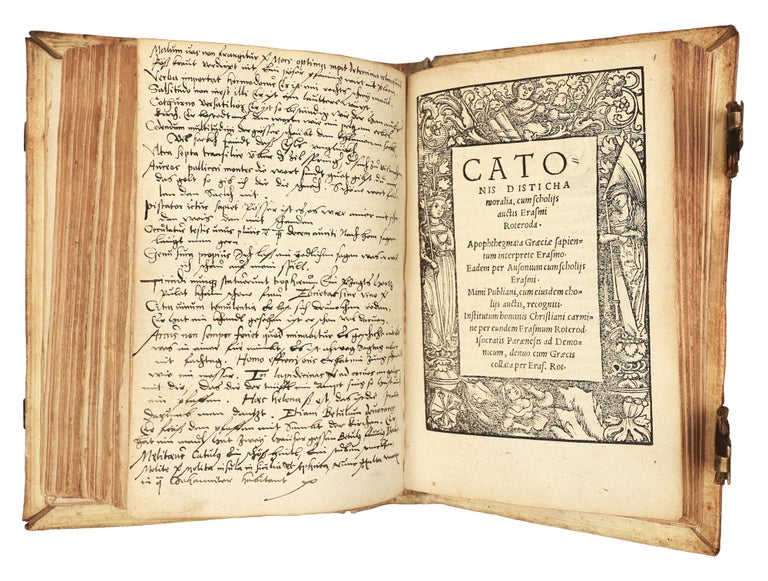
Catonis disticha moralia cum scholiis auctis Erasmi Roterodam... Isocratis paraenesis ad Demonicum. dennuo cum Graecis collata per Eras[mum]
Strasbourg: Johann Knobloch, 1523
Octavo: 15.5 x 10.1 cm. I. (Adagia): [8] lvs, 234 pp., [15] lvs. Collation: A-R8, S4 (with final blank leaf present). II. (Disticha): [56] lvs. Collation: A-G8
Bound in contemporary blind-stamped pigskin with a very early paper label to the spine. In fine condition. The text bound a bit tight. Minor soiling and a few marginal tears or worming. First t.p. working loose at foot. With fine woodcut borders to the title pages of both works, woodcut initials. Knobloch’s device on the final leaf of the second work. The leaf between the two volumes has handwritten notes in German on both sides.
This rare edition of the Erasmus’ “Adagiorum Collectanea”(Collection of Adages) was printed by Johann Schöffer, grandson of Gutenberg’s partner Johann Fust and son of Gutenberg’s successor Peter Schöffer. The fine woodcut border on the title page incorporates Schöffer’s arms. The book is bound with Erasmus’ edition of the “Distichs of Cato”, the “Apothegms of the Greek Sages” and other moralizing texts for use in schools.
THE ADAGES:
The “Adagia”, one of Erasmus’ greatest achievements, is a collection of proverbs taken from both Latin and Greek authors. The work was already conceived during his first stay in England and was first printed at Paris in 1500. The present edition is a reprint of the 1506 edition (which had been expanded by 18 adages). It retains, however, the dedication letter to William Blount Lord Mountjoy (Allen 126) from the first edition. Although it was eclipsed by the massively expanded Aldine edition that was to follow in 1508, the “Adagiorum Chiliades” (“Thousands of Adages”), to which Erasmus would add up until his death in 1536, the much shorter “Collectanea Adagiorum” would continue to be printed as well.
"Erasmus’ ‘Adagiorum Collectanea’ is a collection of about eight hundred proverbial sayings drawn from the Latin authors of antiquity and elucidated for the use of those who aspired to write an elegant Latin style. In the dedication Erasmus pointed out the profit an author may derive, both in ornamenting his style and in strengthening his argumentation, from having at his disposal a good supply of sentences hallowed by their antiquity. He proposes to offer such a help to his readers. What he actually gave was much more. He familiarized a much wider circle than the earlier humanists had reached with the spirit of antiquity.
"Until this time the humanists had, to some extent, monopolized the treasures of classic culture, in order to parade their knowledge of which the multitude remained destitute, and so to become strange prodigies of learning and elegance. With his irresistible need of teaching and his sincere love for humanity and its general culture, Erasmus introduced the classic spirit, in so far as it could be reflected in the soul of a sixteenth-century Christian, among the people. Not he alone; but none more extensively and more effectively. Not among all the people, it is true, for by writing in Latin he limited his direct influence to the educated classes, which in those days were the upper classes.
"Erasmus made current the classic spirit. Humanism ceased to be the exclusive privilege of a few. According to Beatus Rhenanus he had been reproached by some humanists, when about to publish the Adagia, for divulging the mysteries of their craft. But he desired that the book of antiquity should be open to all." (Huizinga, p. 39-40)
THE DISTICHS OF CATO:
The literature of edifying proverbs and “sententiae” enjoyed enormous success during the early Middle Ages. The “Distichs of Cato” were a particularly successful example of this genre, being read widely from the Carolingian period up to the 16th century. The book’s misattributed to the great Roman statesman Cato the Elder (the book is now believed to be a late antique work by a Dionysius Cato) gave the book the weight of authority. From the 12th century onward, the readership broadened and it began to be used outside of the “collective” settings of the schools and universities, as edifying reading for private, personal contemplation.
“Erasmus would return to the subjects taught in his own education through his publications on childhood education. One of these topics would be the Distichs of Cato. Although he had been working with dicta over several years in the beginning of the 16th century, Erasmus claimed that his actual writing of his version of the Distichs took significantly less time. Its first edition was published around 1514 in a book which also included the sayings of Mimus Publianus (Publilius Syrus) and the seven sages, and Erasmus’ translation of the poem Institutum christiani hominis by John Colet. Once published, the edition quickly spread to schools in both England and the Low Countries.
“Erasmus began his edition of the Distichs of Cato with an address to the educator Jean de Nève. In this letter, he criticized two earlier commentaries on the Distichs, one by Robert of Euremodio (ca. 1375) and the other by Philip of Bergamo (also late 14th c.). He believed that Robert’s version was excessively rhetorical (in fact it reflects Robert’s Cistercian intellectual milieu). Philip he chastised for pointless philosophizing. Erasmus wrote in a straightforward, classicizing style, without adducing parallels to scripture and patristic and medieval theologians, so that students could easily comprehend the text. Erasmus focused on the ethical and linguistic education of the student.
“Although his edition of the Distichs was a smaller work than his other publications, Erasmus valued its widespread usefulness in early childhood education. In addition to his polemics against earlier editions and corrections to the text, Erasmus also included aphorisms (often taken from his magnum opus the Adagia. He also briefly clarified historical context, but this often was used to criticize the present rather than provide an understanding of the past. His criticism of errant laity and churchmen (and a general suspicion of his sympathy for the Reformation) led to the censuring of his commentary, which nonetheless prospered.”(Ortega, DSB -Digital School Book- online)
Adagia: VD 16, E-1929; Adams, E-432; Bibliotheca Belgica, E-79; Index Aureliensis 161.954; F. Van der Haeghen, Bibliotheca Erasmiana, Répertoire des oeuvres d' Érasme, (Nieuwkoop, 1961), p. 2. Disticha: VD16 C 1613.